
Anne Clark Hooper
Anne Clark Hooper was born in Wilmington, North Carolina, in 1744 and married William Hooper at Kings Chapel, Boston, Massachusetts, on August 16, 1767. Her parents are Barbara Murray Clark and Thomas Clark, well-to-do merchant, plantation owner and sheriff of New Hanover County, North Carolina.
Her family was opposed to her marriage to William because of their conservative sentiments toward the British and their distrust of William’s radical tendencies toward independence. But the match was an excellent one and together they endured many hardships over the turbulent years to come. Anne’s qualities included the ability to adorn and sweeten social and domestic life. It is also written that she possessed firmness of mind which enabled her to sustain without repining the grievous privations and distresses to which she became peculiarly exposed in consequence of the prominent station which William held in the War of the Revolution.
William Hooper is best known as one of the signers of the Declaration of Independence and his primary concern was the protection of colonial rights. After earning B.A. and M.A. degrees at Harvard College, he became a Circuit Court lawyer. He, along with John Penn and Joseph Hewes, represented North Carolina in the first Continental Congress traveling on horseback over 450 miles on difficult backroads. William served with Benjamin Franklin on the highly important committee of secret intelligence which had broad powers to hire secret agents abroad, make agreements, and even conceal information from the Congress itself.
Six children were born of this union: William, Elizabeth, Thomas, Anenas, an unnamed baby son and infant daughter. Only three of the six children survived to adulthood. The daughter, Elizabeth, married a North Carolina businessman of Hillsborough, Henry Hearne Watters. William, married Helen Hogg of Scotland and had several children who became prominent, particularly the Rev. William Hooper, Professor of Languages at North Carolina University.
James Iredell, a Superior Court judge, who was later appointed by George Washington to the first U.S. Supreme Court, shared William’s political views and corresponded throughout the struggle for American independence. Excerpts from these letters give us some insight into the personality and attributes of Anne Clark Hooper.
In a letter to his wife, Hannah Johnston Iredell, James describes a visit he made to the Hooper home. Anne received him with politeness and cheerfulness making him very welcome. He became aware of her very educated mind and that she could speak articulately about matters of history and events of the day. Anne was a bright and strong-willed woman. About her family James says that they seem so happy with each other and their children. They are very fine children and appear to be sensible, are extremely well behaved and Hooper’s little girl, Betsy, will be pretty.
While William was away Anne and her children were expelled from Wilmington by the British. She and other wives were moved in wagons and allowed to carry with them nothing but their wearing apparel. When William returned to Wilmington, he found his family gone and that the British had broken into his house and taken every article of furniture, cut open the feather beds and totally destroyed his prized collection of books.
William traveled to Hillsborough where he found his family with Anne’s brother, Thomas Clark, Jr., who became a colonel and brigadier general in the Continental Army. Anne had been ill before leaving Wilmington and now was almost unrecognizably thin, and their son, Thomas, had a high fever. The mistreatment Anne had received from “British Major James H. Craig who treated the Hooper family so cruelly that other British officers publicly chastised his conduct” had taken a great toll. It was the fortunate affluence of the Clark family that enabled Anne’s family to survive the difficult years of the American Revolution.
In 1782 the Americans regained control of Wilmington and determined to retaliate for the treatment of patriots and their property under the British by doing the same to loyalist families and possessions. Anne did not think this was proper as it affected women and children who had little to do with the political positions and activities of their husbands. In a striking example of benevolence and empathy, she and several other ladies of Wilmington took it upon themselves to petition the governor urging that this punitive policy not be carried out. Among the twenty-one women who signed “The Petition to Protect Loyalist Families”, Anne’s name was first on the list.
Two years before Anne’s husband died in 1790, he was compelled to give up most of his law practice and other duties because his health was deteriorating due to malaria and a badly broken arm. Anne continued to look after their plantation very successfully as well as caring for their children. The Hooper’s owned the Nash-Hooper House from 1782-1853 seen in the following image. In 1782, Anne and William purchased the former residence of Brigadier General Francis Nash—a home that would become known as the Nash-Hooper House. This acquisition was made possible in part through Anne’s brother, Thomas Clark Jr., who had married Sarah Nash, the widow of General Nash. The Clark family’s influence and affluence, combined with this familial bond, helped secure the home as a place of refuge and renewal for the Hoopers.
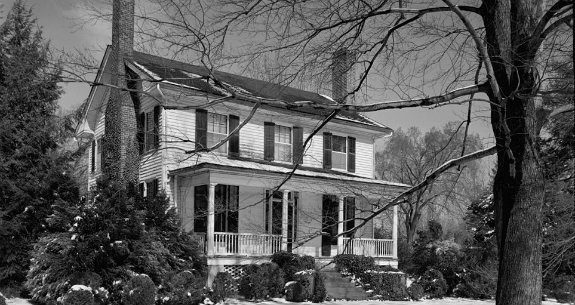
“According to the Library of Congress, The Nash-Hooper House is the only surviving home of a signer of the Declaration of Independence in North Carolina (William Hooper). The main block of the house was built in 1772 by General Francis Nash, one of North Carolina’s most famous Revolutionary heroes. . . . The house itself is a very good example of Piedmont architecture and has suffered few structural changes in its nearly 200 years of existence.”
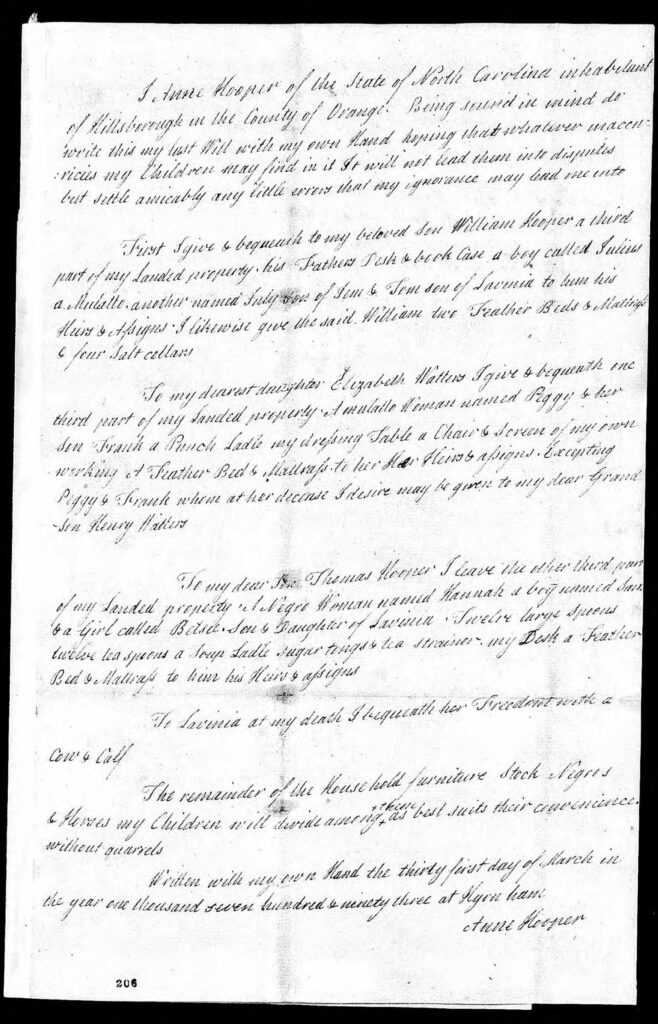
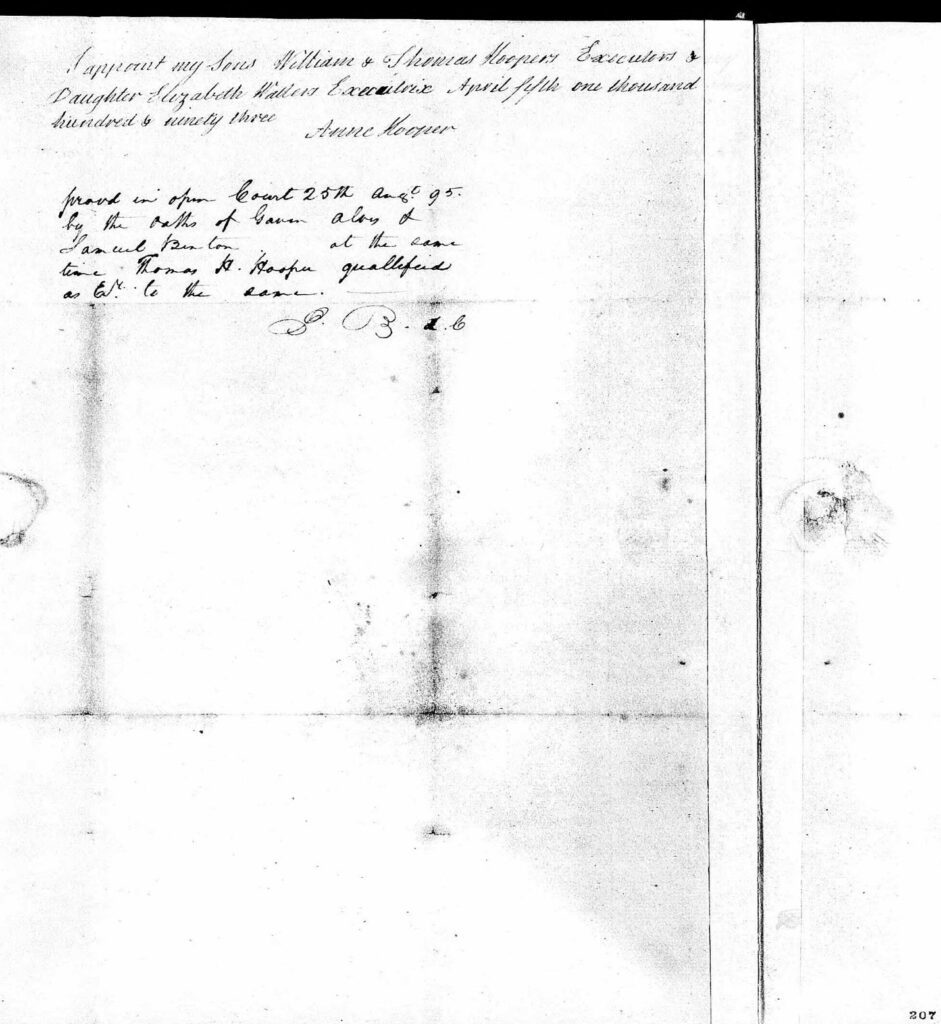
Anne Clark Hooper died at the young age of 51 on May 30, 1795, in the Nash-Hooper House in Hillsborough, having experienced great sacrifices toward American independence. She penned her will on March 31, 1793 and appointed her three living children; William, Elizabeth Hooper Watters, and Thomas as executors on April 5 of the same year. Anne’s exact resting site is assumed to be in the Old Town Cemetery in the area William designated for their burials in Hillsborough, Orange County, North Carolina. A copy of Anne’s Will follows.
Laura Wills Edwards
Descendant – 6th Great-granddaughter of North Carolina Signer William Hooper and Anne Clark Hooper with documentation provided by Margie Amelia Wills, 5th Great-granddaughter of North Carolina Signer William Hooper and Anne Clark Hooper.
Sheryll Pope Albert – Updates September, 2025
Sources
- Higginbotham, Don, ed. The Papers of James Iredell, 1767-1783
- “The Women’s Petition”, Executive Letter Book, Colonial & State Records, vol. 16, pp. 467-69 https://www.ncpedia.org/anchor/petition-protect-loyalist
- Green, Harry Clinton and Mary Wolcott Green. Wives of the Signers: The Women Behind the Declaration of Independence, forward by David Barton, excerpted from The Pioneer Mothers of America, 1912. The pioneer mothers of America: a record of the more notable women of the early days of the country, and particularly of the colonial and revolutionary periods. ULAN Press reprint, original prior to 1923, pp. 259-262.
- The Historical Marker Database, Hillsborough in Orange County, North Carolina-The American South, The Old Town Cemetery. https://www.hmdb.org/m.asp?m=232411 accessed September 4, 2025.
- Hooper Compass, Vol 2, Issue 1, November, 2000. William Hooper, Signer of the Declaration of Independence. https://www.hoopercompass.com/pubs/HC2_2011.pdf accessed September 4, 2025.
- In the Words of Women blog. Archive for the ‘Hooper, Anne Clark’ Category, posted April 9th, 2015 by Janet. Copyright © 2021 In the Words of Women. http://inthewordsofwomen.com/?cat=193 accessed March 8, 2021.
- Kneip, III, Robert Charles. William Hooper, 1742-1790: Misunderstood Patriot, (PhD dissertation) Tulane University, Ph.D., 1980.
- Lawson, Dennis R., Harnett, Hooper & Howe, 1979, pp. 35-60.
- Lowry, Harold D. “William Hooper” The Society of the Signers of the Declaration of Independence, 2006. https://staging.dsdi1776.com/William-Hooper/ accessed March 8, 2021.
- Pyne, Frederick Wallace. Descendants of the Signers of the Declaration of Independence: North Carolina, South Carolina and Georgia, Volume 7, June, 2000, p. 4.
- Nash-Hooper House; https://www.thehistorylist.com/sites/nash-hooper-house-hillsborough-north-carolina, accessed March 2021.
- Will of Anne Hooper; Wills, 1752-1946; Cross Index to Wills, 1752-1946; Author: North Carolina. County Court of Pleas and Quarter Sessions (Orange County); Probate Place: Orange, North Carolina. Ancestry.com. North Carolina, U.S., Wills and Probate Records, 1665-1998 [database on-line]. Provo, UT, USA: Ancestry.com Operations, Inc., 2015.